
Heroes Behind the Headsets

When someone dials 911, the voice that answers doesn’t panic. It doesn’t freeze. It doesn’t get a second chance.
That voice belongs to a highly trained public safety professional, and AFSCME Council 63 members were in Washington, D.C., this week fighting to make sure the federal government finally recognizes that fact.
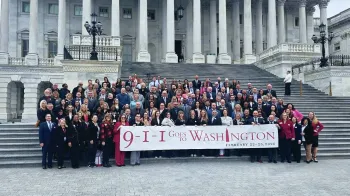
Across the country, 911 dispatchers are still categorized under outdated federal job classifications that lump them in as clerical staff. Anyone who has ever listened to a dispatcher coordinate CPR, manage a multi-car crash, or keep a caller calm while police are en route knows that label doesn’t come close to reality.
That’s why AFSCME NJ members joined with the National Emergency Number Association to push Congress to pass the Enhancing First Response Act and the 911 SAVES Act. Bipartisan legislation that would move 911 professionals into the federal government’s protective service occupation category. The change wouldn’t cost taxpayers more money. It would simply align the law with reality.
New Jersey had a strong voice in those meetings.
Amie Fairman, Council 63 Executive Board Member and President of AFSCME NJ Local #3596, traveled to Capitol Hill to advocate not just for her local’s dispatchers, but for dispatchers statewide and nationwide. She was joined by one of her local’s dispatchers and her Vice President, Tangi Errickson and 911 dispatcher from Local 3044-1, Steve Verry.
“After a full day of training and preparation, I headed to meet with members of Congress where I represented dispatchers not only from NJ but from across the country and shared the needs and challenges they face every day,” Fairman said.
Together, they met with the offices of Representatives Frank Pallone Jr., Donald Norcross, Jeff Van Drew, Christopher Smith, and Robert Menendez, as well as Senators Andy Kim and Cory Booker.
“We came to Capitol Hill to push for passage of the Enhancing First Response Act,” Tangi Errickson said. “Reclassification reflects the reality of the lifesaving work we do every single day. We met with members of Congress and their staff to make clear why this bill matters.”
Their message was clear: this isn’t about a change in title, it’s about bringing federal policy in line with the reality of modern emergency response.
“Some states already reclassified 911. It’s time for the federal government to catch up,” Verry said. “Public safety is always changing. We need to change too.”
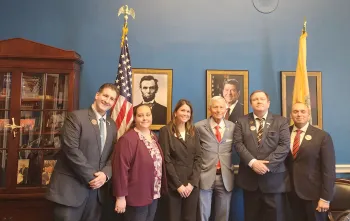
Our AFSCME NJ members lobbied on Capitol Hill alongside other AFSCME members across the country. “We were proud to be there with our AFSCME brothers and sisters from Los Angeles and Pennsylvania,” Fairman said.
What stood out most to Fairman was what happened outside the formal meetings.
Dispatchers from Arizona approached her after learning that AFSCME Council 63 had sent representatives to Washington on behalf of an entire state’s 911 workforce. They wanted to know how to build that kind of power back home. How to activate their union. How to bring AFSCME representation to their members.
“That’s exactly why I love this union. Solidarity matters!” Fairman said. “We showed up, we spoke up, and we represented our dispatchers across the state with pride.”
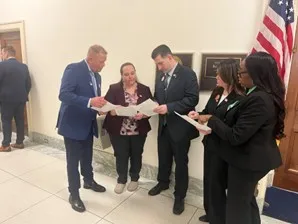
Reclassification isn’t about a title. It’s about respect. It’s about acknowledging the trauma dispatchers absorb, the split-second decisions they make, and the lives they help save every shift. As technology evolves and emergency response grows more complex, proper classification can open doors to stronger training standards, better mental health resources, and a clearer professional pathway.
California Congresswoman Norma Torres, herself a former 911 dispatcher, has been a leading champion of the effort in the House. With bipartisan momentum behind both bills, advocates believe the finish line is within reach.
For AFSCME New Jersey, this trip wasn’t symbolic. It was strategic. It was personal. And it sent a clear message: our members refuse to be invisible.
Because when crisis hits, the first first responder isn’t always the one you see.
As Fairman put it best:
“Heroes wear headsets and carry phones.”